
Monitor rodent activity and body temperature with nano tag™
Collect continuous locomotor activity and body temperature data in mice and rats with minimal intervention—even in group housing environments.
nano tag™ is a trademark of Kissei Comtech Co., Ltd.
Research applications
nano tag™ enables continuous monitoring of rodent locomotor activity and body temperature, making it a valuable tool for a wide range of behavioral, physiological, and preclinical research studies. By collecting long-term data with minimal animal disturbance, researchers can gain deeper insights into activity patterns, thermoregulation, treatment effects, and disease progression.
Explore the applications below to see how nano tag™ can support your specific research goals.
- Behavioral Monitoring
Track locomotor activity and body temperature continuously in rodents to observe physical activity patterns, general behavior, and responses to environmental changes.
- Thermoregulation and Stress Response
Measure and analyze body temperature fluctuations and track stress responses in animals under various conditions, including environmental changes and pharmacological interventions.
- Pharmacological Effects
Monitor the effects of drugs or treatments on animal activity levels and body temperature, supporting research into new pharmaceuticals or behavioral interventions.
- Circadian Rhythm Research
Study diurnal and nocturnal behavior, including the effects of circadian disruptions or shifts, to better understand sleep-wake cycles and their impact on health.
- Social Interaction and Group Housing Studies
Monitor group-housed animals without intervention, enabling the study of social behaviors, aggression, and other dynamics in group housing environments.
- Pain and Sensory Studies
Evaluate pain responses in animal models by observing activity patterns and temperature changes under different conditions, such as stress, injury, or chronic pain models.
- Metabolic and Chronic Condition Monitoring
Assess metabolic changes and track long-term effects of chronic conditions such as obesity, diabetes, or cardiovascular disease on activity levels and body temperature.
- Developmental and Genetic Research
Track developmental changes in activity and temperature regulation across various stages of life, or assess the effects of genetic modifications on behavior and physiology.
- Animal Model Validation
Use continuous activity and temperature monitoring to validate animal models in preclinical research, ensuring they reflect the intended physiological conditions or responses.
- Neurodegenerative Disease Research
Investigate the effects of neurodegenerative diseases or neurological impairments on activity levels and body temperature regulation in animal models.
Simplified monitoring for better research outcomes
nano tag™ simplifies long-term monitoring of rodent activity and body temperature by eliminating tethering and reducing handling. The implantable design enables continuous data collection with minimal researcher intervention, helping researchers gather reliable behavioral and physiological data over extended study periods.
Simple setup
Implant nano tag™ and collect
activity and temperature data with
minimal daily intervention.
Unrestricted Movement
Monitor animals in their
home cage without tethering
or restricting movement.
Long-term monitoring
Collect continuous activity
and temperature data over
extended study periods.
Featured Research
Improving Reproducibility in Pain Research with nano tag™
Behavioral pain studies often suffer from variability caused by researcher interaction and manual assessments. Researchers at the Institute of Science Tokyo evaluated nano tag™ as a hands-free approach to monitoring activity and body temperature in a knee joint pain model, helping improve consistency while enabling continuous data collection.

Download the case study to learn:
- Why conventional behavioral assessments created reproducibility challenges
- How nano tag™ was incorporated into a pain research workflow
- What insights researchers gained from continuous activity monitoring
How nano tag™ works

nano tag™ provides a simple workflow for continuous rodent activity monitoring and body temperature measurement without tethering or frequent animal handling.
Step 1: Implant the Device
Implant nano tag™ subcutaneously in mice or rats to begin long-term activity and body temperature monitoring.
Step 2: Collect Data
nano tag™ records locomotor activity and body temperature continuously according to your selected recording interval.
Step 3: Read and Analyze
Transfer data to nano tag Viewer software for visualization, analysis, and export.
Flexible data collection to match your research goals
Designed for long-term studies
nano tag™ combines a compact implant design, long recording duration, and flexible sampling intervals to support both short-term behavioral studies and extended monitoring experiments.

Compact Implant Design
Suitable for mice and rats with minimal impact on routine study procedures.
Long Recording Duration
Collect activity and temperature data for up to 60 days without intervention.
Flexible Recording Intervals
Configure sampling intervals to match your experimental requirements.
Recording duration examples
Recording duration depends on the selected temperature and activity intervals. Use the examples below to compare how different recording settings affect the available monitoring period.
| Temperature Interval | Activity Interval | ||||||
|---|---|---|---|---|---|---|---|
| 12 sec | 30 sec | 1 min | 2 min | 4 min | 5 min | None | |
| 12 sec | 4 days | — | — | — | — | — | 9 days |
| 30 sec | 6 days | 10 days | — | — | — | — | 22 days |
| 1 min | 7 days | 13 days | 20 days | — | — | — | 45 days |
| 2 min | 8 days | 16 days | 25 days | 37 days | — | — | 90 days |
| 4 min | 8 days | 18 days | 30 days | 47 days | 60 days | — | 180 days |
| 5 min | 8 days | 18 days | 31 days | 50 days | 60 days | 60 days | 180 days |
| 10 min | — | — | — | — | — | — | 180 days |
| None | 9 days | 20 days | 36 days | 60 days | 60 days | 60 days | — |
Swipe horizontally to view the complete table.
Recording durations are estimates and may vary based on device settings and study conditions.
nano tag™ Viewer Software
Configure recording settings, review locomotor activity and body temperature trends, and export collected data for further analysis with nano tag™ Viewer Software.
Configure
Set device options and select recording intervals based on your study requirements.
Visualize
Review locomotor activity and body temperature trends in an easy-to-read interface.
Export
Export collected data as CSV files for statistical analysis and reporting.
Reader compatibility: nano tag™ Viewer Software is compatible with NFC readers RC-S300/S1 or RC-S300/S. NFC readers are sold separately.
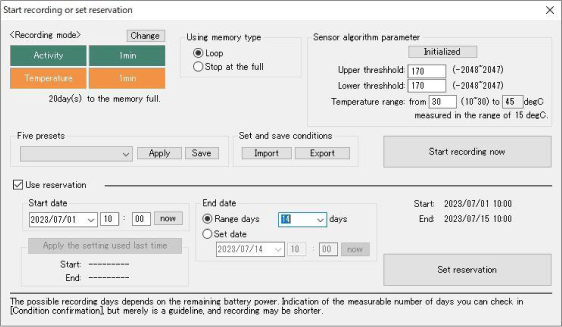
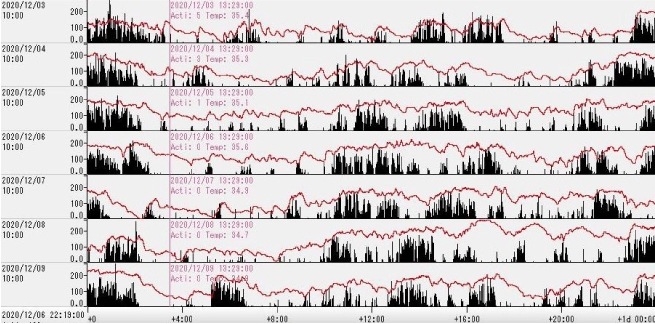
Included with the nano tag™ Demo Set and compatible with full nano tag™ systems.
Evaluate nano tag™ in your laboratory
Explore nano tag™ in your own laboratory before investing in a full monitoring system.
The nano tag™ Demo Set provides a hands-on introduction to activity and body temperature monitoring for a single animal, making it easy to evaluate the workflow, software, and data output.
Included in the demo set
✓ nano tag™ device
✓ nano tag viewer demo software
✓ Data visualization and export tools
✓ Single-animal monitoring capability
nano tag™ Demo Set
$291.00
Evaluate the workflow, software, and data output in your own laboratory.
Need a larger system?
Looking to monitor multiple animals or discuss a specific application? Contact our team for full system configurations and pricing.
Publications
Explore peer-reviewed studies using nano tag™ in behavioral, physiological, and preclinical research applications.
A novel methodology utilizing microchip implants to monitor individual activity and body temperature for assessing knee pain in group-housed rats.
Hasegawa, S., Yamashita, R., Nakagawa, Y., Miyatake, K., Katagiri, H., Nakamura, T., … & Tsuji, K.
(2024). Scientific Reports, 14(1), 16909.
Phenotypes for general behavior, activity, and body temperature in 3q29 deletion model mice.
Mori, D., Ikeda, R., Sawahata, M., Yamaguchi, S., Kodama, A., Hirao, T., … & Ozaki, N.
(2024). Translational psychiatry, 14(1), 138.
Mice with deficiency in Pcdh15, a gene associated with bipolar disorders, exhibit significantly elevated diurnal amplitudes of locomotion and body temperature.
Mori, D., Inami, C., Ikeda, R., Sawahata, M., Urata, S., Yamaguchi, S. T., … & Ozaki, N.
(2024). Translational Psychiatry, 14(1), 216.
Risperidone suppresses caffeine-induced hyperthermia and hyperactivity in rats.
Takano, M., Okada, T., Shioda, K., Yonekawa, C., & Suda, S.
(2024). Neuroscience Letters, 840, 137960.
Effect of chronic intermittent hypoxia on ocular and intraoral mechanical allodynia mediated via the calcitonin gene-related peptide in a rat.
Katagiri, A., Kishimoto, S., Okamoto, Y., Yamada, M., Niwa, H., Bereiter, D. A., & Kato, T.
(2024). Sleep, 47(3), zsad332.
Technical specifications
Review nano tag™ device dimensions, materials, sensing capabilities, recording intervals, and data export options.
| Specification | Details |
|---|---|
| Size | 18.8 × 14.2 × 7.1 mm |
| Weight | 2.7 g |
| Materials | ABS resin, epoxy adhesive |
| Sensors | 3-axis accelerometer and temperature sensor |
| Battery Life | Approximately 60 days |
| Waterproof | Yes |
| Communication | NFC (Near Field Communication) |
| Recording Intervals | 12 seconds to 10 minutes |
| Data Export | Graphs and CSV files |
Swipe horizontally to view the complete table.
Frequently asked questions
Find answers about research applications, compatible animal models, recording duration, data analysis, device handling, and the nano tag™ Demo Set.
What is nano tag™ used for?
nano tag™ is an implantable monitoring device used to measure locomotor activity and body temperature. It can support behavioral, physiological, pharmacological, circadian rhythm, pain, and disease model research requiring continuous or long-term monitoring.
Can nano tag™ be used in group-housed animals?
Yes. nano tag™ allows activity and body temperature data to be collected with minimal researcher intervention, making it suitable for studies involving group-housed animals.
What animals can be used with nano tag™?
nano tag™ is commonly used in mice and rats. Suitability for other laboratory animals depends on animal size, study design, and implantation considerations. The device is not intended for animals smaller than mice. Contact our team to discuss your specific model.
What data does nano tag™ measure?
nano tag™ records locomotor activity and body temperature. The selected recording intervals determine how frequently each data type is collected.
How long can nano tag™ record data?
Recording duration depends on the selected activity and temperature intervals. Shorter intervals provide greater data resolution, while longer intervals can extend the available monitoring period. Refer to the Recording Duration Examples table above for sample settings.
How is nano tag™ data collected and analyzed?
Recorded data is transferred using a compatible NFC reader and reviewed in nano tag™ Viewer Software. Researchers can visualize activity and body temperature trends and export collected data as CSV files for further analysis.
Is nano tag™ waterproof?
Yes. The nano tag™ device is waterproof. Laboratories should follow their approved implantation, sterilization, and animal-care procedures when preparing and using the device.
Can nano tag™ be reused?
Reuse depends on the laboratory’s study requirements, handling procedures, and approved cleaning or sterilization protocols. Contact our team for guidance regarding your intended workflow.
Is the nano tag™ Demo Set suitable for evaluating the system?
Yes. The Demo Set provides a hands-on introduction to nano tag™ monitoring for one animal. It includes a nano tag™ device and nano tag™ Viewer Demo Software so researchers can evaluate the setup, data collection, visualization, and export workflow before considering a larger system.
How do I select the right nano tag™ system configuration?
The appropriate configuration depends on the number of animals, recording intervals, study duration, and data collection workflow. Contact Amuza to discuss your research requirements and full-system options.
Ready to evaluate nano tag™ for your research?
Whether you’re planning a pilot study or a larger monitoring project, our team
can help you determine the right nano tag™ configuration for your application.