
TaskForcer Semi-Restraining System: Faster, Focused Training for Behavioral Research
Enhance training precision and speed with TaskForcer, the ideal partner in operant conditioning.
When research animals are stressed or distracted, training slows, and results may vary. Unlike other systems that allow rodents to move freely while performing tasks, the TaskForcer eliminates distractions and enhances data accuracy.
Train rats and mice in just three days with this innovative system!
- The body-restraining system keeps subjects focused solely on the task.
- The unique spout-lever combines operant task and reward, ensuring seamless training.
- The modular design allows for easy customization and reproducibility.


Ohara-TaskForcer-WholeSetwithGonio
On Imaging Adapter Base Mount

Ohara-Licking-Unit-with-Adaptor
Licking Unit with Adapter

Ohara-Mouse-Restrainer
Mouse Restraint

Ohara-TaskForcer-WithStereoTaxic-edit
With Stereotaxic for Neural Recording
Streamlined Training
TaskForcer’s body-supporting cylinder keeps rodents comfortably restrained and focused, allowing for faster training times.
Customizable Setup
Create the ideal training environment with customizable stimulus, reward, detection methods, and output/software options.
Integrated Imaging
Image simultaneously during behavior with the adjustable base mount, offering precise control of X, Y, and Z axes.
Interested in seeing TaskForcer in action?
Request a demo, and we’ll show you how it can work for your research.
See TaskForcer in action and learn how it enhances training efficiency.

Free Application Note Download
Download our application note to see how TaskForcer integrates with optogenetics and PET brain imaging.
Detailed Steps for Customization
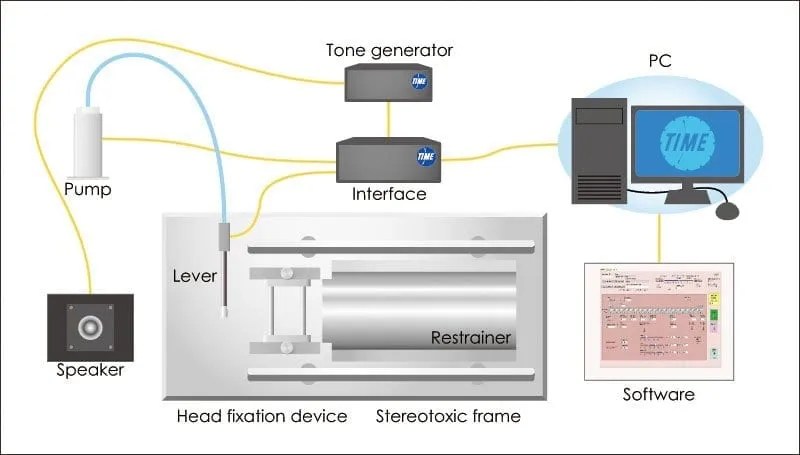
1
Choose Stimulus
Options include sound, light, odor, and visual cues.
2
Choose Reward
Dispense a consistent shot of water or liquid solution.
3
Choose Detection Method
Use licking detection, a lever unit, or the unique spout-lever.
The TaskForcer Story
His breakthrough was a body-supporting cylinder to calm rats and help them focus on the task while leaving their forelimbs free to move. He also developed methods to habituate rats to the system. The resulting high-throughput training structure was the foundation of the TaskForcer made by O’Hara.
Watch TaskForcer in Action

Recent Publications


Ipsilateral-dominant control of limb movements in rodent posterior parietal cortex.

Recent Blog Articles

Use head-fixation to identify neurons associated with voluntary movements
Head-fixation is widely used in the field of behavioral neuroscience in awake behaving animals to better understand the cortical involvement in animal behaviors.

Image simultaneously during behavior with the TaskForcer
What’s unique about the imaging adapter base mount is that you can adjust x y and z positions, which allows you to adjust the TaskForcer angle under the 2-photon microscope.

A solution for precise optical imaging during head-fixed behavior
A major roadblock with the cranial window and optical imaging approach is the alignment of the mouse under the microscope. We offer the solution.
Partner with Amuza for Your Behavioral Neuroscience Needs
As the exclusive U.S. distributor of TaskForcer by O’Hara & Co., Ltd. made in Japan,
Amuza is committed to supporting your research with advanced, reliable equipment and expert guidance.